Wednesday, February 27, 2013

Pauldrons

I'd thought that it would be appropriate (after a long hiatus) to upload some content! This is a brief look at how we will be approaching tier content in the first couple dozen levels. Rarity of an item will not just be the color in your inventory, but also a completely different look to show off in-world. 

Media for Dungeon Painter will soon be posting from another blog soon. For now, here are some modular pauldrons.

(Work in progress, baked ambient occlusion )


Thursday, September 13, 2012

Approaching Winter

I've recently been experimenting with texture shaders provided by Shadmar (user on Leadwerks forums). Crysis pioneered the technique with several other texture-based directional effects, and have since changed the way developers create models. This effect is now common place, from Skyrim to Guild Wars 2.

Here's a test using the model from my previous posts.


Wednesday, February 15, 2012

Rounded Corners

Throughout the lifecycle of several projects, many were brainstorms of much larger projects of which seemed unimaginable. The rush to dive into the development of these games, seized the potential from these projects because neither creator nor artisans of the trade properly planned each step. This caused previous projects to crawl to a halt, which ends now.

Several project members have left the team, and in-turn a new project (or phoenix) is born once again. There will be public alphas, video updates, and additional stages that will give the public the chance for feedback. The new game in development is called "Dungeon Painter 3D".


The concept is simple: give a player paintbrush that will draw dungeons, cities, and dangers. What type of world would they create, and how detailed would their worlds be? The project will allow each user to collaborate by building their own realms, forming adventures for other players through the"Dungeon Painter 3D" tool set.

These semi-transparent blobs are actually the beginnings for one of the first dungeons created with this real-time paint tool.

Progress so far:
- Core algorithms
- Basic Dungeon models

Up next... textures, stalagmites, and treasure!

Sunday, July 31, 2011

Crates Updated


I've refined the details of the Crate set and modified the broken pieces to better suit customers. I'm working on eliminating several polys that are unnecessary, and hopefully will have these posted on the Leadwerks Asset store soon!

Wednesday, July 13, 2011

Crate Mania


I have been incredibly busy during the last couple of months! Creating a pathing library written in LUA, Several models, and concept art for my multiplayer game. Here is a sampler pic of an item that will go on sale soon on the Leadwerks website.

This crate has a script that will explode into a handful of broken pieces with random rotation and velocity, shown in the picture below.

The lower resolution crate only appears when the camera is 200 units (or farther) away.

(Pieces, Hi-res, Lo-res)

Wednesday, February 17, 2010

Modeling Practice

The Leadwerks community is in need of some quality models that are professional grade. My next project is to create a construction set for caves, made from only a handful of pieces. The pictures below shows some of my progress.


Wednesday, February 10, 2010

AI Path Finding

I had a challenge last week from my partner for this game project. Allow an NPC to come up with a quick way to navigate to a particular place, even if the environment around him is dynamic.

Some high-budget games use static node path meshes, which must be a final step in production for each map. A combination of theses meshes in different formats have been used in different games, and some use smoothing algorithms to make the web of node seem more natural. I wanted a different approach that didn't require a web of objects hand placed into the world.

I came up with a rotational path collection.
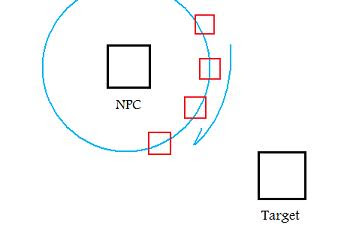

On a pivot, a box would rotate several degrees and create a collection of distances from the target. After the closest one is found, it adds this entity to a PathCollection, then moves the pivot to this new closer spot.
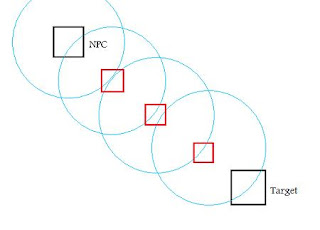
The cycle repeats itself until the radius is close enough to the target.
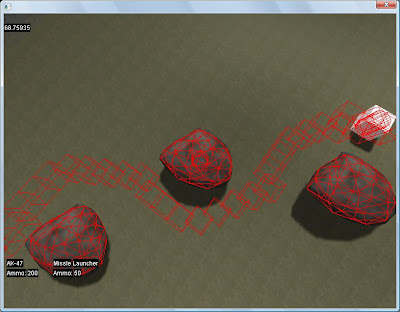

I used a collection of Entities to avoid storing a minimum radius, and calculated terrain slope to manage where NPCs can actually travel. Changing the rotating radius and amount of degrees for each iteration can be used to create a low-density path compared to my example.

The best part about this approach is you can store these paths in memory, removing the data as necessary.

Saturday, January 30, 2010

2.3 Evaluation Kit

Josh has Released the 2.3 Evaluation Kit. The only sandbox where you can render God Rays, SSAO, and Tens of Thousands of trees on a Single Core 1.2GHz Processor.

Monday, November 9, 2009

Follow up


You'll be seeing some screenshots as I continue to create the media for the game. At the moment I'm building low-poly castle walls with hi-res sculpts for normals. Each can be destroyed and picked apart slowly, nearly brick by brick. I'm using a technique that partially replaces the model for physics-based objects, depending on the severity of the damage

Thursday, October 29, 2009

Respite

I have worked on an Untitled project with another development team for some time, but as with most small teams dedication is hard to find. The team I was invited to decided to allow me a respite, and time to experiment with the Leadwerks API.

This hiatus from another team gives me a change to work on my own original project. Here is one of the beginning narrations from the beginning of the game:

Novel: " As I scale the icy mountains to destroy what I have sought for several years now, a single thought of dedication passes through my mind. I am known as Novel, and I now walk to my death. "

I now have a complete title name for anything that I produce: `Rekindled Phoenix Software`

Wednesday, August 19, 2009

Custom Particle Effects

So, to help out the people in charge of graphic design I created a custom application that allows you to make particle effects dynamically using XML. This small app uses the Leadwerks Engine to create the possibility of hundreds of particle emitters. When it launches, it scans for a settings file with parameters. These parameters manage velocity, size, and rotation of all of the particles.

Particle Creator Alpha is currently in use by my graphics team.


To see how the application works, click here!
http://www.youtube.com/watch?v=A2irFmcX--w

Thursday, July 30, 2009

Networking

Leadwerks has a simple networking class, one that I am happy Josh includes in the engine. Sadly, it's not enough to include communication layers, simulating smooth network traffic, and even security. Something that as a programmer, I'm happy to be able to download.

RakNet is a wonderful networking solution, and is seems it's filled with more goodies than an easter egg basket. This is more than a recommendation, this is a must download for anyone who has an independently funded game.

They can be found here
www.jenkinssoftware.com

Saturday, July 18, 2009

Turrets

I've been having some fun with Leadwerks' particle emitters, creating several turrets with the click of a mouse.


First experiment with particles


Second try at particle flames

Sunday, July 5, 2009

Restucture

I'm currently working on restructuring the code behind my game to accept settings files, which will be written in xml. At my current job, these are the most versatile files in our programs. When each program or service loads, it looks for an xml file, parses the tags and using reflection applies any properties that have the same name as the xml tags.

After that, I'll have to create code to handle multiple players. I'm working on something much larger than joust...

Tuesday, June 30, 2009

A New Direction

This week I had a discussion with an old game developer that I met at work about an abandoned project. It was going to be a remake on the old classic Joust, except with a much darker artistic style. Our goal for the game was to create a multilayer environment that's enjoyable for anyone willing to play a platformer.

Back then, we didn't have the right tools, nor the time. Torque 3d was our first solution, though I wasn't willing to learn an entirely new coding language just for the project. Soon after, it was scrapped. I continued on with my project, and we never thought to reinitialize the game. Well, much like a rekindled phoenix to the flame, the old project is born again.


It took me 10 minutes to code a simple platformer in Leadwerks 2.0, when it would have taken months with Torque 3d.

WIP Example shots.


My personal project which is much more advanced that this, will be put on hold for now. You'll see more progress on both projects soon.

Monday, June 22, 2009

Models

Here are some low-poly models I made a couple weeks ago for this project.

Monday, May 11, 2009

Cameras

Recently I have been having issues developing camera types. Because of the complexity that some designers require for cameras in-game, a third person camera does not come out of the box compiled with the physics engine. It's also easy to code, unless you're me.

Last weekend I developed a third-person camera after several coding glitches causing wasted time. Coding an complete game suite is hard when you do it all yourself! Below are some screenshots of the minor progress made with both first and third person cameras using the mouse to rotate.


On thing I love about Leadwerks is the fluidity in which the world is coded. Add a camera, light, and anything else you need (even out of order sometimes) and the graphics engine takes care of the rest.